By the time you can see the nest, it no longer matters
An Asian hornet nest is easy to spot in December. It hangs at the end of a branch, the size of a football, plainly visible from the road. That is exactly the problem: by then the colony has finished its work. The founding queens have left to overwinter elsewhere, and what you are looking at is an empty shell.
Through the whole season that counts, from June to October, that same nest is invisible. It sits high, often above fifteen metres, and the foliage hides it completely. You know it exists because the hornets are there, hovering in front of the hives, picking off foragers on their way home. You just do not know where.
That gap is what a thermal drone closes: finding the nest while it still counts.
What a thermal camera sees of a live nest
An active nest is a body that produces heat. Figures reported by the pilots who do this work are consistent: 28 to 30 °C inside, and a surface above 20 °C.
That heat depends on neither the hour nor the weather. Everything else does.
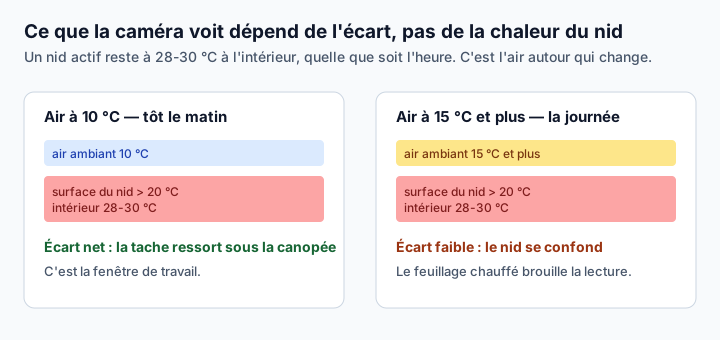
A thermal camera does not measure a temperature, it measures a difference. On a morning at 10 °C, a nest above 20 °C stands out sharply against cold foliage. As soon as the outside air climbs towards 15 °C and the sun has warmed the leaves, the same nest sinks into the noise. Practitioners say it plainly: at 15 °C, detection becomes difficult.
The practical consequence decides the rest of the day: you fly early. Thermal search for hornet nests is first-light work, or late-season work, when the night has cooled the canopy and the sun has not yet caught up with it.
Two public tests, two outcomes: the sensor decides
Thermal searching for hornet nests has been filmed and published by several practitioners, and comparing their tests is where the lesson sits.
AIRD'ECO-Drone, which runs the Bees for Life programme, released a side-by-side comparison of the same scene in thermal and visible light: the nest stands out as a clear patch in the canopy, with no room for doubt.
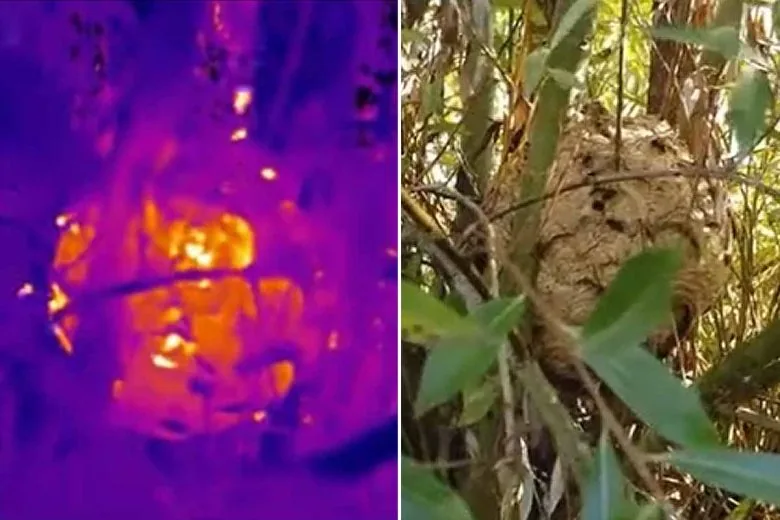
Activity of an Asian hornet nest, compared in thermal and standard view. Credit: AIRD'ECO, Bees for Life programme.
Read the two halves in reverse order: on the right, in visible light, you have to know where to look to tell the nest from the branches. On the left, it jumps out. That is the whole point of the method, and the whole reason the sensor matters.
Étienne Roumailhac, who runs Landes Guêpes Frelons in Toulouzette and trains people for the certibiocide certificate, published his own with an entry-level dual-sensor aircraft. The result is honest, and he says so himself in the video: the sensor is too weak, the distinction is not sharp. The nest does not separate enough from the foliage to conclude anything.
The two tests do not contradict each other. They say the same thing from two angles: the method works, the equipment decides. A low-definition thermal camera on a general-purpose aircraft will not separate a nest from sunlit foliage. A proper radiometric sensor on an aircraft built for it will.
That nuance is usually left out, and it is the one that decides whether the morning was worth anything. An operator who buys the wrong aircraft will conclude that thermal does not work, when all he measured was the limit of his sensor.
One thing the second test gives that the first does not: it shows what failure looks like, which is more useful than a success when you are deciding what to buy.
A warm patch is not yet a nest
Thermal gives a lead, not a conclusion. A trunk facing the rising sun, an animal, a cable, a shed roof all return a warm signature too.
The chain that works uses two cameras in sequence: thermal finds, visible confirms. You descend, zoom, identify shape and species, and only then decide to act. The aircraft used for this carry both sensors on the same gimbal, which saves flying the site twice.
That full chain has been documented over an apiary: thermal survey of a wooded area, abnormal heat in the canopy, high-definition visual confirmation, treatment the next morning. In the days that followed, pressure on the apiary was cut by a factor of ten.
What the kit does, and what it will not do
Searching needs two sensors on one gimbal: a radiometric thermal camera and a visible camera with a usable zoom. That is what aircraft in the Matrice 4T or Alpha class carry: find on thermal, switch to visible without landing.
Three limits deserve to be stated plainly, because they shape the result more than sensor resolution does:
- foliage stops infrared. A thermal camera does not see through leaves, it sees the heat leaving them. A nest buried deep in a dense crown may let nothing through, whatever the machine;
- wind erases the contrast. It stirs the warm air the moment it leaves the nest and flattens the signature;
- recent rain distorts everything. Wet foliage drying in the sun produces warm patches everywhere.
Thermal does not replace knowing the ground: it speeds up a search someone has already aimed, from the affected apiaries and the observed flight lines.
Filming a nest is free, dropping a pellet into it is not
This is the part most articles on the subject leave out.
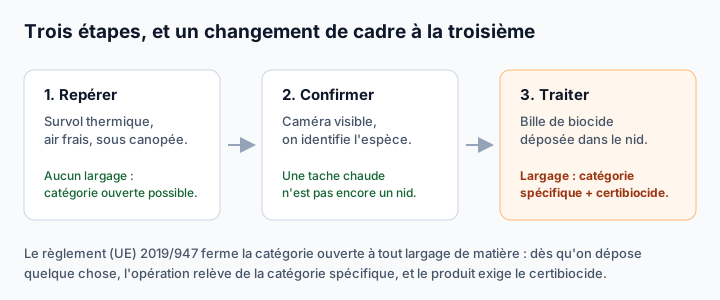
Finding a nest means flying with a camera. Treating it means putting something into it. And Regulation (EU) 2019/947 forbids an unmanned aircraft from dropping any material at all in the open category. A biocide ball placed into a nest is a drop, with no room for argument.
Such an operation therefore falls under the specific category: operational authorisation, standard scenario or risk assessment, with everything that implies in declarations and competence. It is not paperwork you sort out afterwards.
The product has its own regime. In France, professional-only biocides of product type 18, insecticides and products against other arthropods, which covers hornets exactly, require the certibiocide certificate from the user, the distributor and the buyer, under the order of 9 October 2013 as amended. Without it you can neither buy the product nor use it.
Two conditions, two authorities, and neither follows from the other. A drone perfectly legal to fly is not thereby legal to treat with.
What others are trying
The ball is not the only route. French manufacturers offer drones fitted with an injection lance, reproducing in flight the gesture made from the ground for years with a telescopic pole: approach the nest, inject, withdraw.
The offer exists and is sold. What is missing should be said too: no public results allow anyone to measure its effectiveness today, or to compare it with the pole. Pages presenting it mention approval thanks to a parachute, which is worth correcting: a parachute answers the risk of falling on people; it does nothing about the ban on dropping. Two separate requirements, and meeting one does not excuse the other.
Who acts, and who pays: the French case
This is the question people actually ask when they find a nest, and the answer often surprises.
⚠️ This section describes French law. The species' European status applies everywhere in the Union: the yellow-legged hornet is listed as an invasive alien species of Union concern by Implementing Regulation 2016/1141, which bans keeping, breeding, transporting or releasing it across all twenty-seven member states. But who orders a destruction, who pays for it and which professional may carry it out are national matters, and in France often municipal ones. A Belgian, Spanish or Portuguese reader will find a different national plan, with its own bodies.
In France, the Asian hornet holds two statuses at once: category two health hazard for honey bees since the order of 26 December 2012, and invasive alien species of Union concern since Regulation 2016/1141, carried into French law by the order of 14 February 2018. The national control plan is run by GDS France and FREDON France, and Law 2025-237 of 14 March 2025 gave it its own statutory basis.
In practice:
| Situation | Who decides |
|---|---|
| Nest on private property | The owner, free to call whoever they choose |
| Organised control across an area | The prefect may order destruction |
| Who pays | Depends on the municipality or department, with no national rule |
Firefighters are not the default contact, contrary to a widespread belief. The useful reflex is to call the town hall, which points to the local body, or to go straight to a professional nest remover.
It is a trade of its own, and it is taught: Landes Guêpes Frelons, in the Landes, removes hornet and wasp nests across the whole south-west, recovers bee swarms rather than destroying them, and trains for the certibiocide certificate. That same certificate governs buying the product, whatever the means used to place it.
There is also a dedicated reporting platform: Bees for Life tracks traps and reported nests, and connects individuals, municipalities and professional removers. Reporting a nest takes a form, and it is worth doing even if you do nothing else: a known nest is a nest someone can deal with.
Already working on nests? Make it visible
Two trades share this article, and the directory now tells them apart.
- You already have a listing: find it and claim it: claiming hands you control of it.
- You have no account yet: create one, it is free and the listing builds itself from your company registration number.
- In the app, open My organisation, section Activities. Tick Ecology & wildlife, then, under Sub-activities, tick Invasive species nest treatment if you intervene, or Invasive species mapping if you only do the finding.
The two boxes do not say the same thing, and that is deliberate: someone looking to have a nest treated does not want to land on a provider who can only locate it.
The calendar decides everything
The hornet season runs longer than the fawn season, but it has the same property: what is not prepared at the right moment cannot be caught up.
| When | What is at stake |
|---|---|
| February - April | Trapping founding queens, around apiaries and former nests |
| May - June | Primary nests, low and small, still easy to reach |
| July - October | The secondary nest is high and hidden: thermal season |
| November - December | The nest is finally visible, and empty |
A search launched in November protects nothing that year. It maps the ground for the next one, which has value of its own, but nobody should tell themselves a story about what it changes now.
What everyone can do: trap early, but trap right
One nest treated is one nest. Asian hornets are not settled by a handful of well-run interventions: they hold the ground, and pressure only drops where many people act at the same time. It is a collective problem, and nobody has a solution that excuses everyone else from acting.
The most accessible move remains trapping founding queens in early spring. A queen caught in March is a nest that will not exist in August, and beekeepers who trap around their apiaries year after year see it in their own pressure.
It should also be said that measuring that effectiveness is not settled, because that is exactly what the reader will find elsewhere. France's Muséum national d'Histoire naturelle holds that the effectiveness of spring trapping is not demonstrated at territory scale, which is not the same as saying it is nil.
Its reasoning deserves to be given in full, because it is rarely quoted: a large nest produces more than five hundred founding queens, and spring is precisely the season when most of them die, through competition to establish themselves. Around nine in ten disappear on their own. Removing a few therefore mostly frees space for the rest.
And its recommendation is not "never trap": the Muséum advises against spring trapping outside a scientific framework, and reserves it for apiaries heavily attacked the previous year. That is a far more field-aware position than it is usually given credit for.
Large campaigns give mixed results: Wallonia caught more than 40,000 queens in spring 2026 with 134,000 traps across 190 municipalities, while some Swiss cantons saw their nest counts rise despite hundreds of queens taken.
What everyone does agree on is where trapping earns its place: around apiaries, near former nests, on the recurring hotspots. Trapping where the hornet comes back beats trapping everywhere.
The trap matters as much as the gesture
This is the part nobody disputes, and the part most often overlooked.
Bottle or bell traps, the kind built in ten minutes with a drop of syrup, catch on average 96 to 99 % of insects that are not the target. The figure explains why they are ruled out: dozens of species killed, pollinators among them, for a few hornets.
⚠️ In France this is no longer advice: the national control plan bans them. Bottles, bells and jars are excluded as non-selective, and only listed traps are allowed: Japanese traps, Korean winged traps, and mesh traps with a physical separation between bait and catch chamber. Elsewhere in Europe the rules differ; the selectivity figure does not depend on any border.
Cone-box traps, with bait made inaccessible, bring non-target catches down to around 30 %. None is neutral, but the gap between the two is what separates a useful gesture from a harmful one.
Three consequences:
- do not improvise your trap. The equipment improves year on year, and specialists know what is most selective this season. Last year's tutorial does not;
- check it often, to release the insects that were never the target;
- join an organised scheme where your region runs one. Several health federations publish a spring trapping protocol: same traps, same dates, same records. Coordinated trapping teaches something; a hundred isolated traps teach nothing.
And the cheapest, most useful act remains reporting. A nest seen, even empty in winter, is information: it says where the queens spent the summer, and therefore where to trap next spring.
Everyone acting really is the key. It counts most when it is targeted, selective and shared.