What happens in a meadow in May
A doe does not hide her fawn by accident. In its first days, the young animal does not follow its mother: it stays flattened in the tall grass, motionless, almost odourless. That reflex is what saves it from the fox — a predator hunting for movement and scent finds neither.
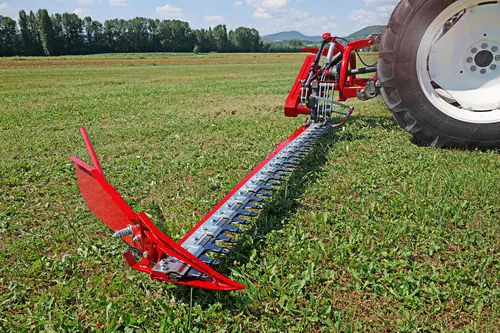
Faced with a mower, the very same reflex condemns it. The fawn does not flee. It flattens.
One word deserves clarifying, because it often misleads: a fawn is not only a deer's calf. It is the name given to the young of every deer species — red deer, roe deer, fallow deer — for as long as it wears its spotted coat. And that russet coat scattered with white is no ornament: it is the second half of the camouflage, cut to imitate flecks of light in the grass. Meadows mown in May concern them all.
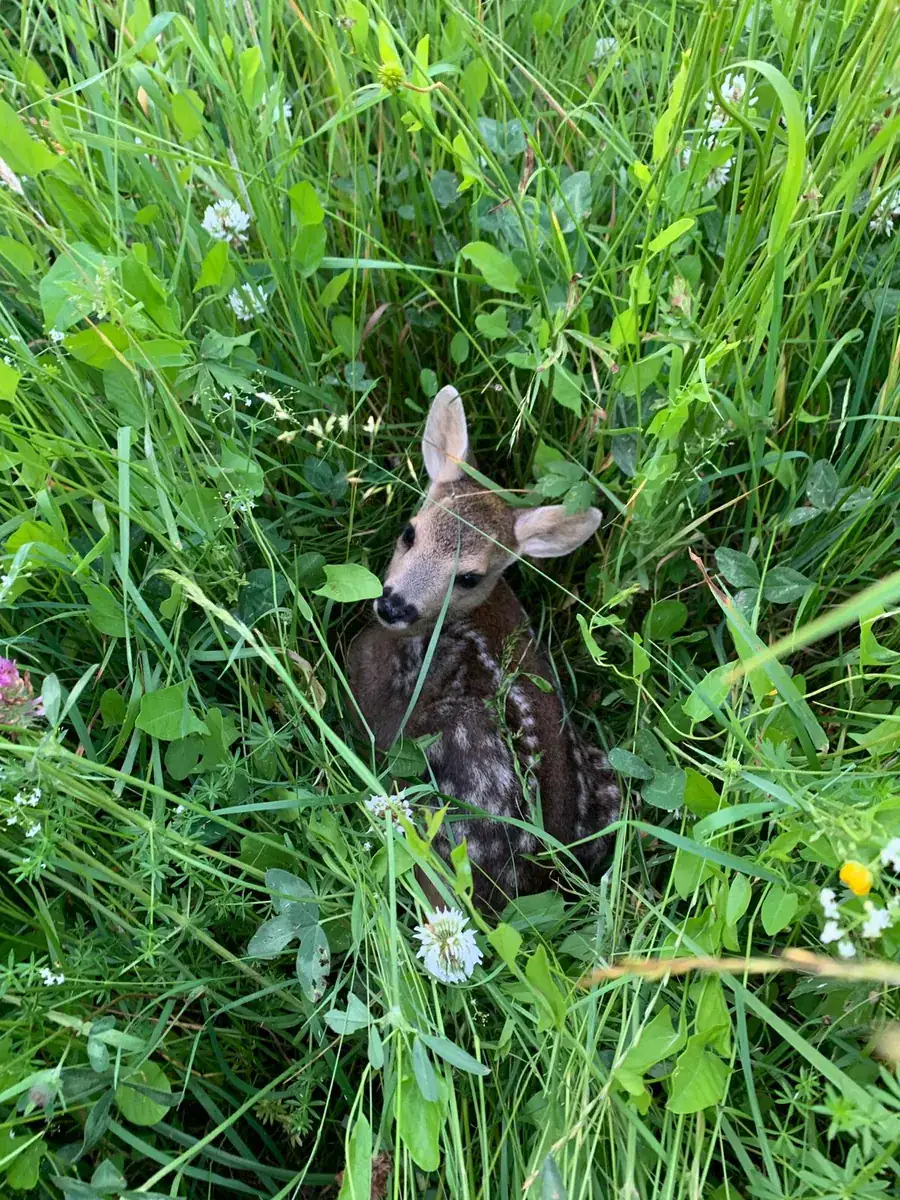
Look at the image above for a few seconds before reading on: this is exactly what a driver sees from the cab, at several kilometres per hour, behind a cutter bar several metres wide.
And the calendar leaves no margin. The birthing season coincides with the hay harvest, in May. Both things happen in the same place, within the same fortnight.
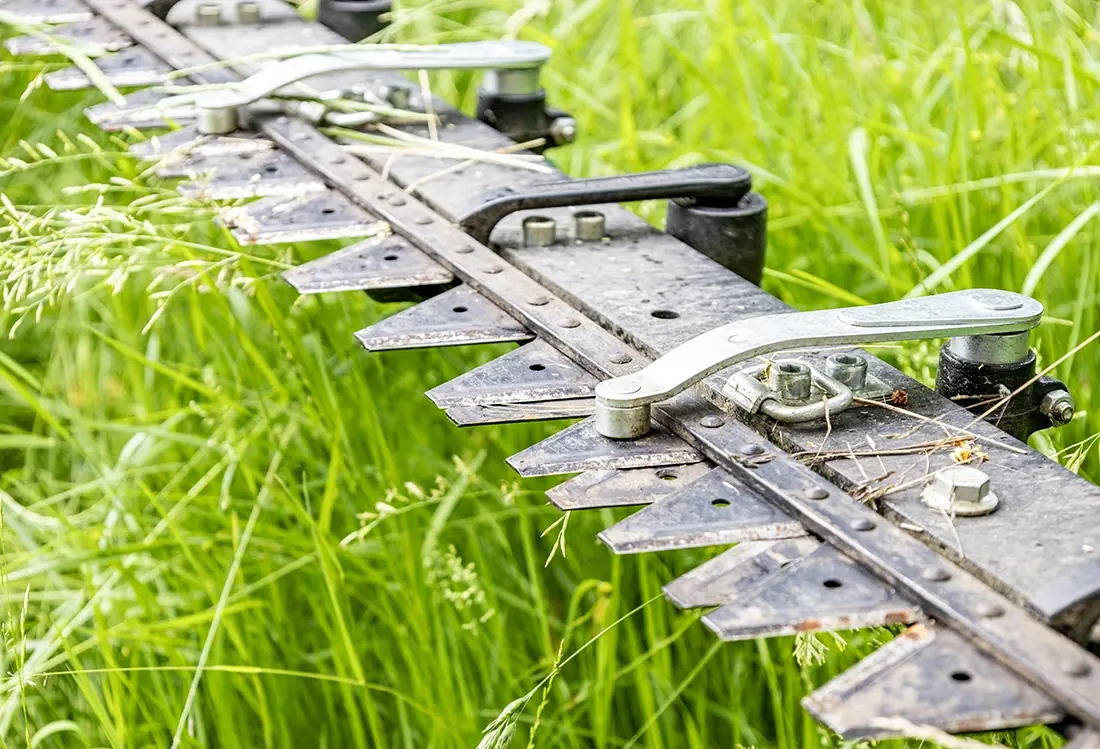
Nobody is at fault in this story, and the farmer least of all. They mow when the weather allows, which often leaves only two or three days to decide. And from the cab, no amount of vigilance can spot an animal flattened in tall grass — you have just checked that for yourself in the photograph. They do their best, with what they can see.
One day, perhaps, machines will see for themselves what the driver cannot — a cutter bar that stops on its own in front of a heat source. Until then, it is your help they need.
The doe, meanwhile, has chosen the strip along the wood, the one mown last. Only one piece of information is missing: where are they?
Sauvons les Faons
That is the answer offered by the French association Sauvons les Faons: volunteers, drones fitted with thermal cameras, and a flight over the field before the mower enters it.
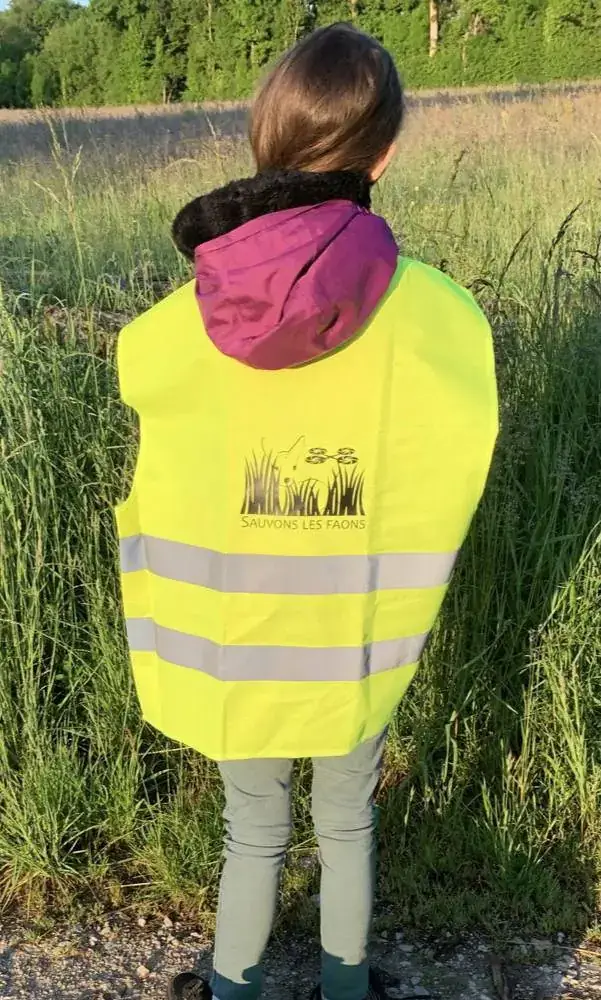
The first trials date from 2018: about ten fawns found in two three-hour outings. Since 2020, the association counts its rescues in the hundreds. It operates notably in the Pays de Gex, Le Mans Métropole and Font-Romeu, and works with the Fondation 30 Millions d'Amis, the Fondation Brigitte Bardot and the LPO.
For the farmer, the service is free.
Why thermal works — and only at dawn
A thermal camera does not see shapes: it sees temperature differences. A fawn at 38 °C lying in grass at 12 °C is an obvious white dot. The same fawn in a meadow warmed all day by the sun disappears into the noise.
Hence the constraint that governs everything else: you fly at first light, before the ground has caught up with the animal's temperature. In peak season that puts the outings between five and six in the morning, depending on place and date.
The window is short, and it is taken within the rules: flying before sunrise is not the same regime as a daytime flight, and it is the remote pilot's job to have checked that before taking off.
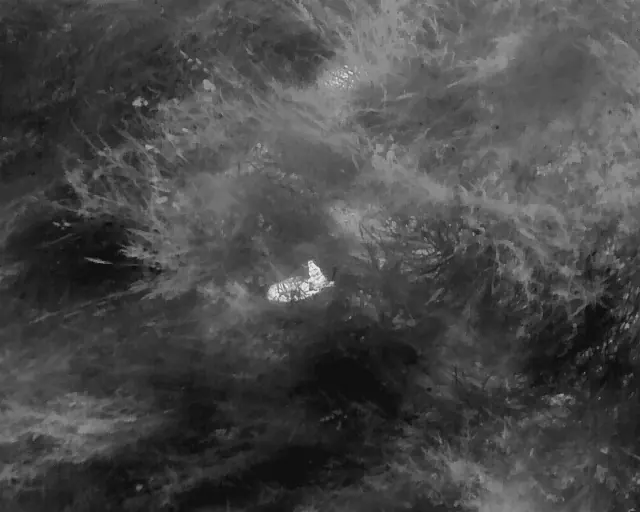
Raw sensor image, 640 × 512 pixels. The bright patch at the centre is a thermal signature: that is all the pilot needs to see in order to send a team to the right spot.
Placed side by side with the visible view, the demonstration speaks for itself.
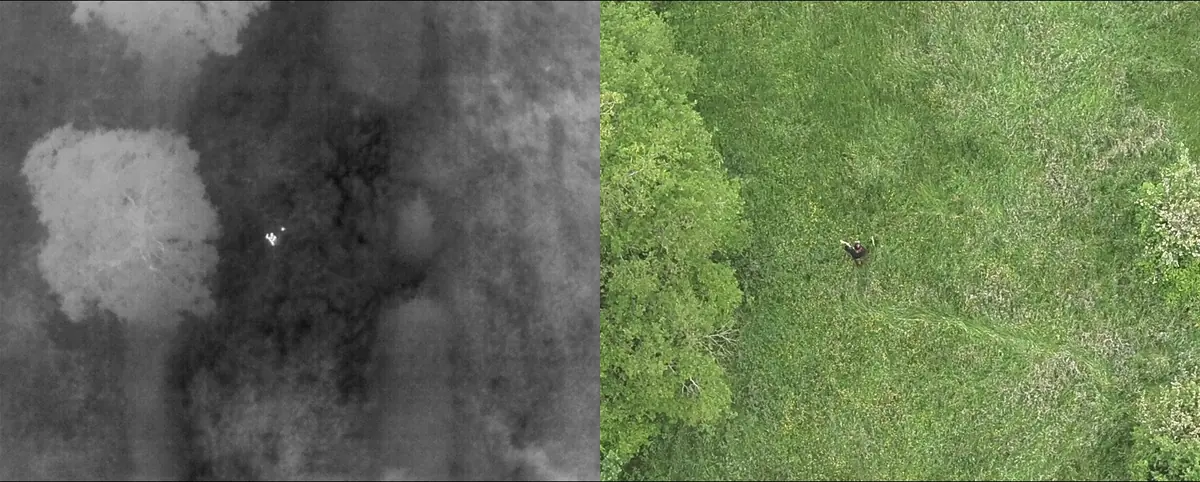
Thermal on the left, visible on the right, at the same instant and from the same aircraft. On the left, the signature leaps out. On the right, you have to know where to look.
An outing, step by step
- Beforehand, with the farmer. You locate the fields to be mown and identify the risky areas — typically the strips bordering a wood.
- At daybreak. The drone grids the field. The association reports roughly ten minutes for ten hectares.
- On detection. The pilot keeps the spot on screen and guides a team on foot by radio to the exact place.
- Moving to safety. Very young fawns are moved with the usual precautions to avoid leaving human scent on them — a doe may abandon a young animal that smells of people. Older ones are guided out of the field, away from roads.
- The mowing. It starts behind, on a field known to be empty.
And nothing is guaranteed on our side either. Thermal sees what is warm and exposed, not what a bush hides; an animal can come back between the flight and the mowing; a thirty-hectare meadow is covered less thoroughly than a three-hectare one. What the method changes is the order of magnitude, not the certainty. Saying so is the least we owe a farmer who gets up at five to help.
What equipment it takes
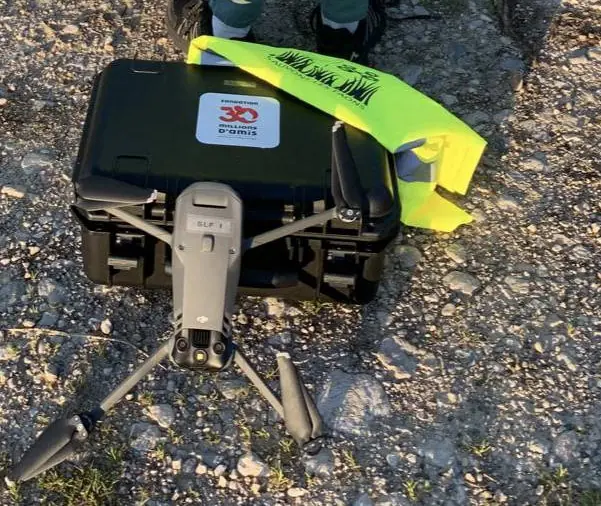
A dual-sensor drone — thermal and visible — is enough, provided the thermal feed is usable in flight: that is the case with aircraft such as the DJI Matrice 4T, Matrice 4D or Autel Alpha.
The rest is method: fly low enough for the animal to be more than one pixel, high enough to cover the field before the sun climbs, and keep the aircraft in sight. The rules that apply to the flight itself are everyone's rules, and they are summarised in our drone regulations guide.
You are a farmer or an agricultural contractor
Get in touch about a week ahead. You do not need a firm date — you do not have one yourself, it depends on the weather. A cutting window is enough to organise volunteers, and you can refine it later.
What the association asks of you on the day, and it is little compared with what is at stake: two people, ventilated crates and stakes with marker tape to mark the zones.
You are a drone pilot with a thermal camera
This is exactly what the association is short of: equipped pilots, everywhere. Three hours on a May morning, a few times in the season.
Two steps, and they do not overlap. The first puts you in touch with an association that organises searches. The second makes you findable by the farmer looking for someone thirty kilometres from your home, whom the association will never know about.
Declaring yourself available on Waypoint360
Ticking the speciality takes a minute, and it is what brings you up when a farmer is looking for someone for their meadow rather than for a sprayer or a surveyor.
- You already have a directory listing — most operators are already there. Find it and claim it: claiming gives you control of it.
- You do not have an account yet — create one, it is free and the listing is built from your company registration number.
- In the app, open My organisation, section Activities. Tick Ecology & wildlife, then, under Sub-activities, tick Wildlife search before mowing.
That is all. You then appear in the search filtered on that speciality, with your coverage area.
⚠️ It is open, and it is in beta. You can declare yourself whether you are a professional, a public service or a private individual.
⚠️ For a private individual or a public service, that declaration stays private: it appears in no public list. Only professionals are listed in the directory.
If you are a private pilot, tick the “Ecology & wildlife” activity from your profile and receive the requests from your area, exactly like a professional. You can also mark yourself unavailable for a week without unsubscribing from the service altogether.
Over to you. It is in beta: your feedback will move things.
Preparing for next season
The season is short: from mid-May to the end of June, in the main. Anything not ready in April will not be ready in time.
| When | What |
|---|---|
| February – March | Map the equipped pilots, area by area |
| April | Contact the farms, agree the risky zones |
| Mid-May – end of June | The flights, at daybreak, following the mowing |
| July | Take stock, correct, keep the contacts |
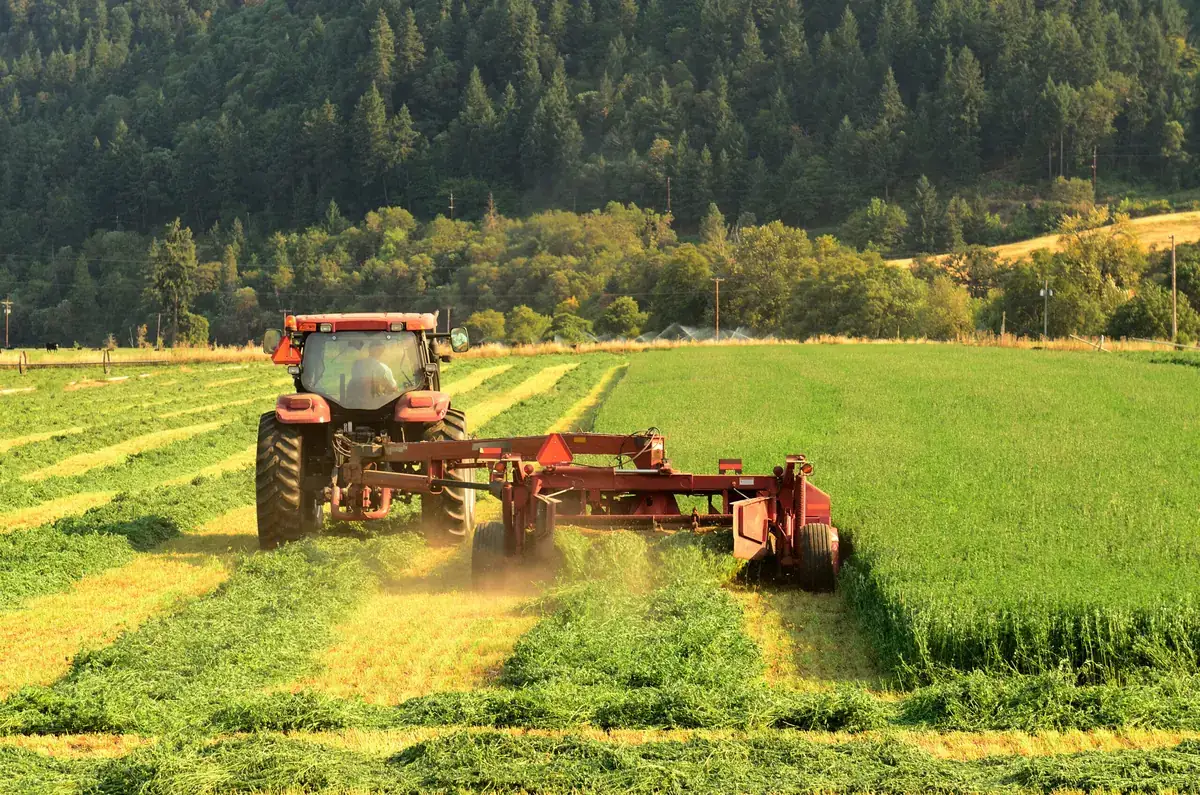
The aim of the whole chain fits in this image: that the farmer does their job, on their date, without having to think about it.
Supporting the association
Sauvons les Faons runs on volunteers and donations. If this speaks to you, the link below goes straight to them — we expect nothing in return.